
6 Ways to Use Riddles to Enhance Your Teaching
What has a beginning but no end, and a classroom full of students ready to learn? The answer is an engaging lesson that uses riddles to get kids engaged in learning!
You can transform your teaching by adding in a bit of mystery and play. Riddles, with their blend of logic, language, and problem-solving, are a secret weapon for any educator. They can help activate prior knowledge in math and solidifying phonics skills. Riddles are a simple yet powerful tool to make lessons more effective and, most importantly, more fun.
Let’s look at six ways you can use riddles to enhance every aspect of your teaching.
Hook Students with an Engaging Lesson Opener
- How to Use Riddles: Start your lesson with a riddle related to the day’s topic. This instantly captures attention, activates prior knowledge, and builds anticipation.
- Example: For a science lesson on states of matter, you could start with a riddle about ice: “I’m solid, but when you heat me up, I disappear. What am I?” For a math lesson on addition, a number riddle could work: “I am greater than 5 and less than 10. If you add me to 3, you get 11. What number am I?” (8)
Strengthen Phonics and Vocabulary Skills
- How to Use Riddles: Word riddles, like “Hink Pinks,” challenge students to think about sound patterns, rhymes, and word meanings simultaneously. This strengthens the crucial connection between sounds, spelling, and vocabulary.
- Example: For a 1st-grade phonics lesson on consonant blends: “I’m the opposite of bumpy and and I rhyme with ‘sat.’ What am I?” (flat). For a 3rd-grade vocabulary lesson on synonyms: “I’m a synonym for tired and I have a long e sound. What am I?” (sleepy). If your administration is asking, these types of riddles are aligned with the Science of Reading’s focus on linking phonemes, graphemes, and meaning.
Reinforce Math Concepts and Problem-Solving
- How to Use Riddles: Math riddles force students to apply numerical reasoning, a mix of logic and calculation, to solve a puzzle. This goes beyond simple computation and develops students’ critical thinking skills.
- Example: For a place value lesson: “I have 4 tens and 7 ones. What number am I?” (47). For a geometry lesson: “I have four equal sides, but my angles are not 90 degrees. What shape am I?” (A rhombus). This makes math practice a fun challenge rather than a repetitive drill.
Math riddle cards will keep your students actively using both math skills and critical thinking! Primary Inspiration by Linda Nelson has tons of math riddle resources over on Teachers Pay Teachers. Here is just one (Add and Subtract Within 20), and it’s a dollar deal!
Provide Differentiated Instruction
- How to Use Riddles: You can easily adjust the complexity of riddles, which make them a perfect tool for differentiation. You can offer various riddle sets to different student groups based on their skill level.
- Example: For students needing a challenge, use riddles with fewer clues or more complex vocabulary. For students who need more support, use simpler riddles with visual aids or some extra clues. This allows all students to engage with the same concept at their appropriate level, providing both remediation and enrichment.
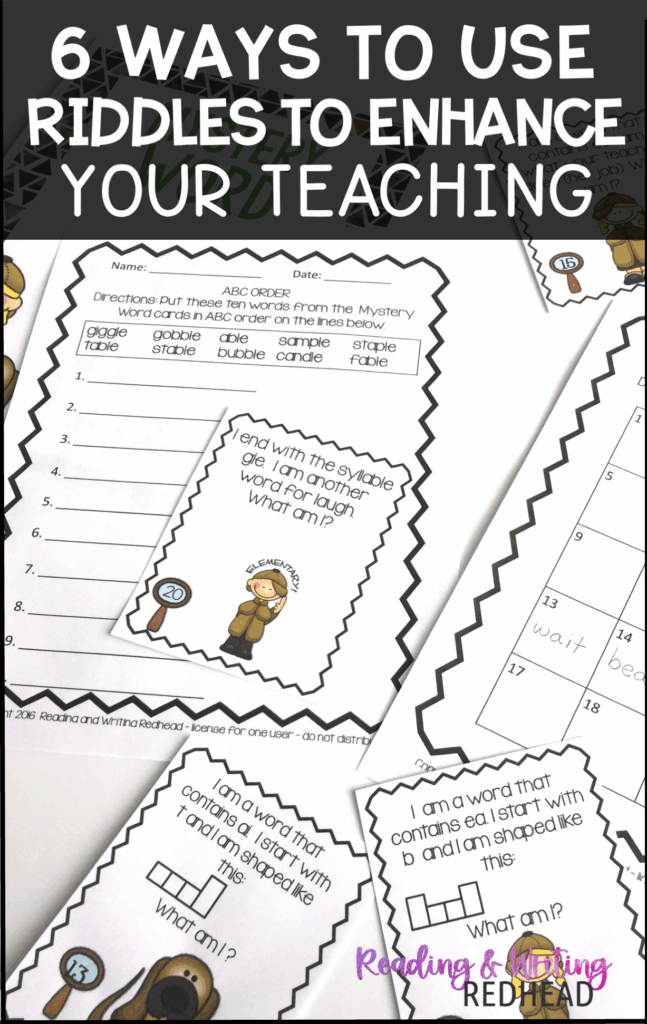
For example, my Mystery Word Phonics Riddles can be used as is, or a group of students could use the resource word list which provides a bank of the answers and scaffolds the activity so all students can answer the riddles.
Keep reading for more tips!

Create Engaging Learning Centers or Stations
Example: Set up a “Riddle Station” where students work to solve a set of phonics or math riddles. They can check their answers using a provided key, which encourages self-correction and reduces the need for constant teacher oversight, freeing you up to work with small groups. For example, I would place the answer key to phonics word riddles in a labeled folder, and my second graders could head over to check their work when they were done, or when they solved most of the phonics word riddles and were only stuck on a few.
Pro Tip: task cards with riddles are ideal for independent or small-group work. They give students a self-correcting activity that provides immediate feedback and promotes independence.
Build Critical Thinking and Metacognition
- How to Use Riddles: Solving a riddle requires students to analyze clues, synthesize information, and draw logical conclusions. When they share their thought process (“I knew it was a square because it had four equal sides, and the last clue said it was not a rectangle”), they are practicing metacognition—thinking about their thinking. Other students can learn a lot by hearing how their classmates solved riddles, too.
- Example: After a student solves a riddle, ask them, “How did you figure that out? Which clue was the most helpful?” This simple question encourages them to verbalize their reasoning and reinforces the problem-solving strategies they used, building a skill that is transferable across all subjects.
Ready to Go Activities from Teachers Pay Teachers
Tired of phonics feeling like a chore? And are you looking for a fun way to boost phonics retention and address those tricky patterns? The Science of Reading Word Riddles are designed to keep kids engaged and learning, moving away from repetitive worksheets into interactive learning centers where students eagerly apply their phonics knowledge (and also sneak in some critical thinking skills and group work practice if you have students work together to solve the riddles) .
Click on the cover to take a peek at TPT.

Key Benefits of This Resource for Teachers:
- Versatile Use: Perfect for small groups, independent work, or with teacher assistants/parent volunteers.
- Cost-Effective: It’s a bundled product, offering a discount compared to purchasing individual sets, making it a budget-friendly option.
- Comprehensive: they cover the vast majority of phonics skills from kindergarten through grade 3, which also allows you to differentiate at your grade level.
- Supports Phonics Instruction: The activities align with the Science of Reading, providing practice for essential phonics skills.
Benefits For Students:
- Engaging Learning: The Mystery Word Riddles format makes learning phonics and spelling fun and interactive.
- Skill Development: Students practice important phonics and spelling skills, helping to reinforce their literacy development.
- Problem-Solving: The riddles encourage students to use critical thinking and problem-solving skills to deduce the mystery words.
- Independent Practice or Group Work: The task card format allows for independent word work, fostering self-reliance in learning OR you can have small groups work together, practicing group work skills.
Let’s peek at a few samples of this resource in action!
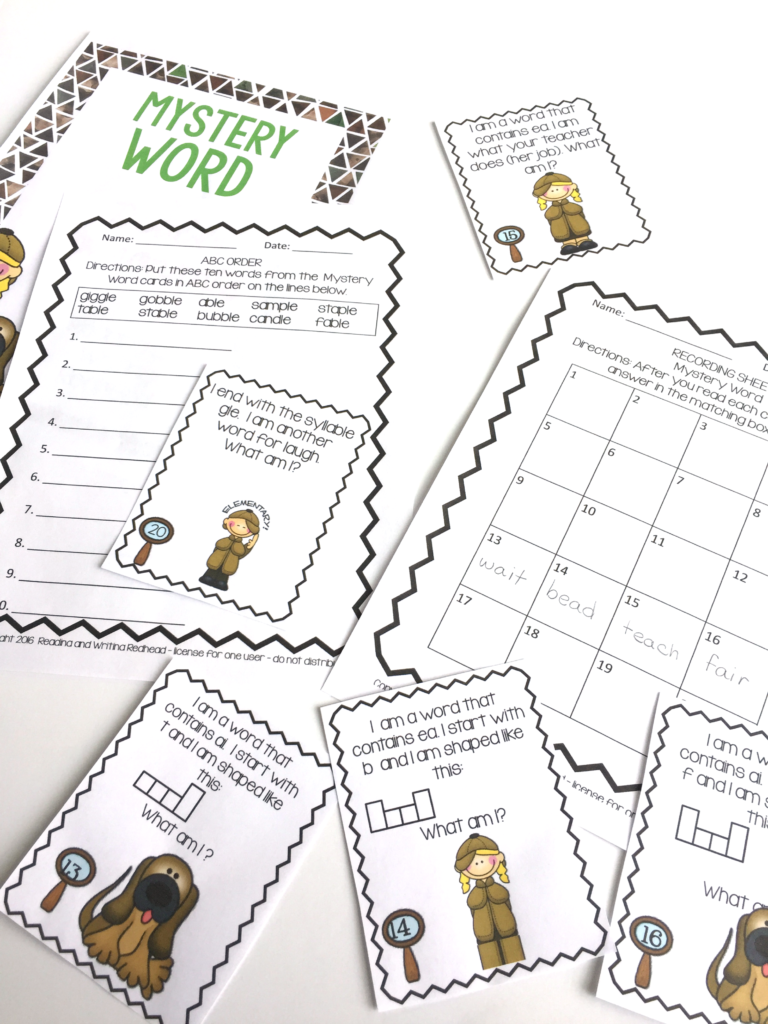
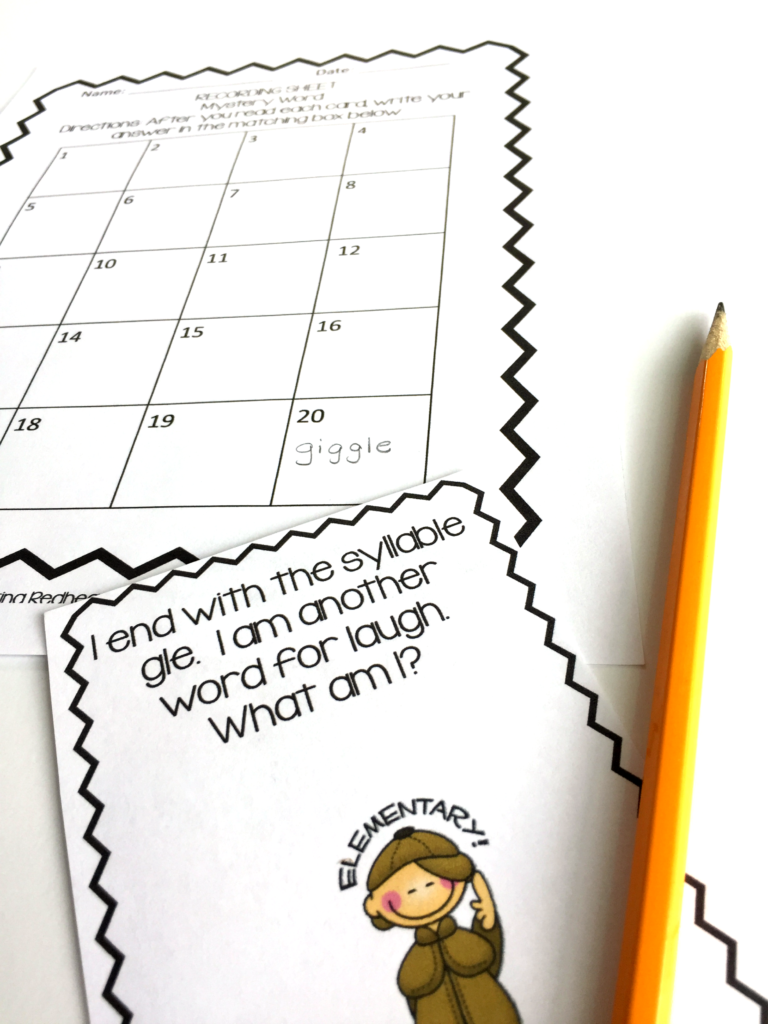
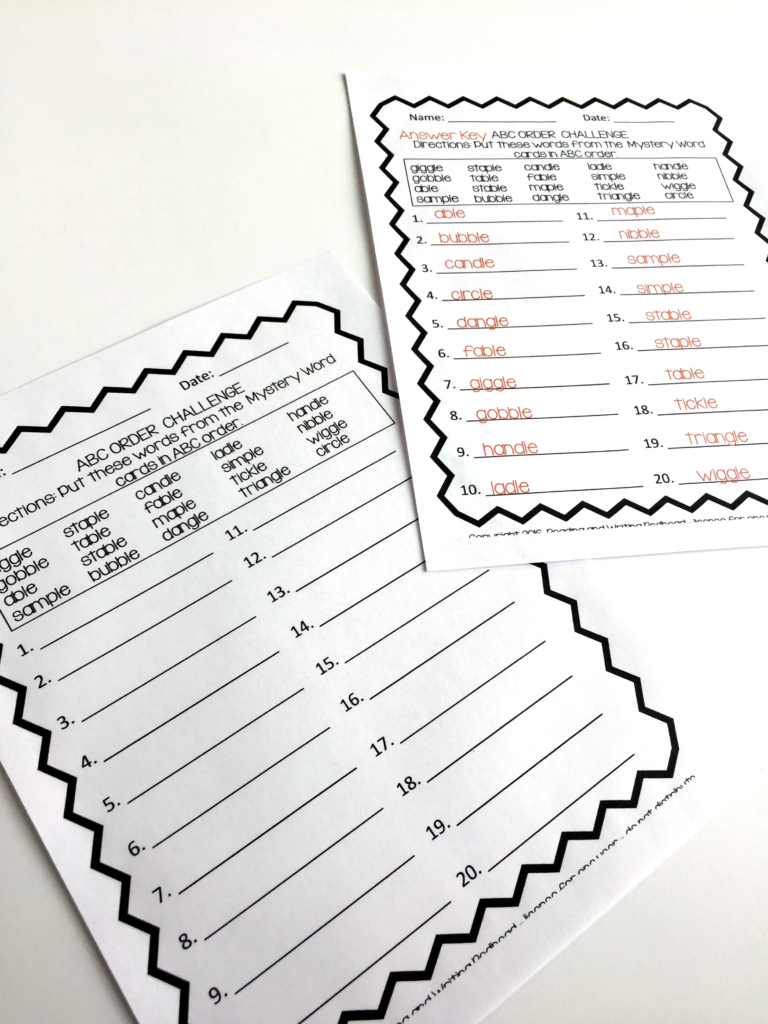
Bonus materials include two differentiated ABC order activities and a word list to help students who need a little support solving the riddles.
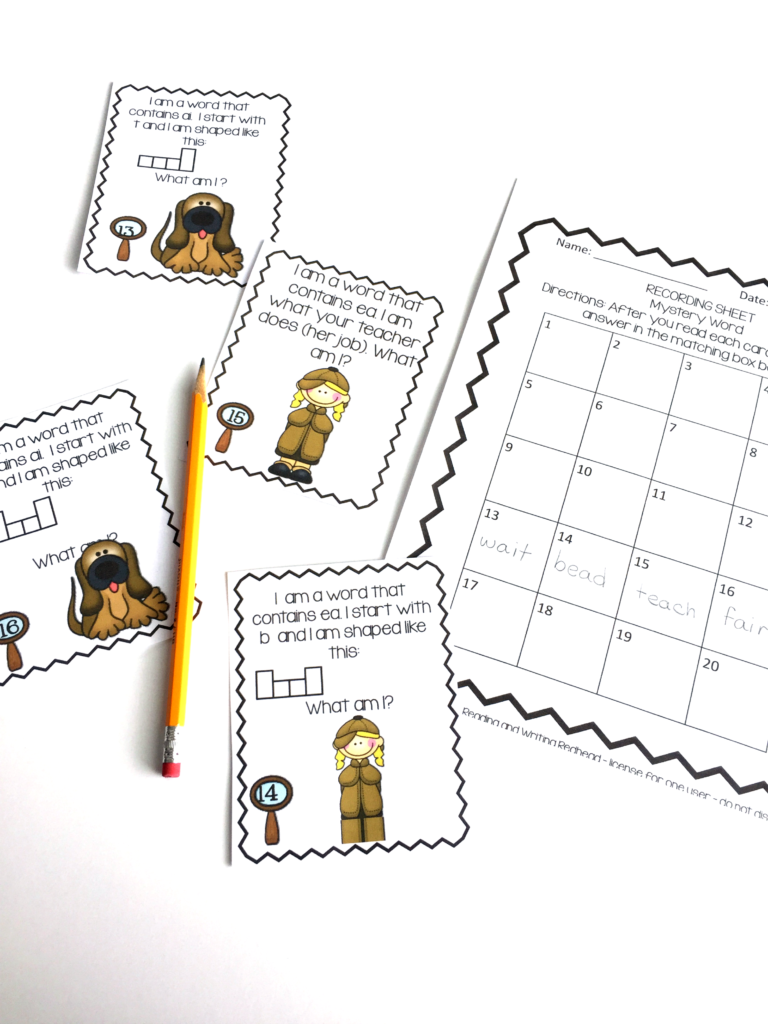
There are so many phonics (and grammar) topics addressed in these word work riddles! If you don’t want the bundle of all of them you can buy them individually (click on their names below to check them out).
- Short vowels
- More short vowels
- Consonant digraphs
- Consonant blends
- R controlled vowels
- Vowel digraphs
- Silent E (vCe syllables)
- Floss rule and vowel teams
- Consonant le words (final stable syllables) (the best selling individual resource)
- Double Vowels
- Double Consonants
- Long vowels
- Y as a vowel
- Homophones
- Antonyms
- More Antonyms
- Synonyms
- Suffixes
Ready to watch your students’ skills soar?! Check out the comprehensive word riddles bundle here! You save 30% with this versus buying each word riddle set separately!
Other blog posts you may want to check out:
- Boost History Skills Now: Kid-Friendly Teaching Tips
- 5 Ways to Boost Phonemic Awareness Now for Your Early Learners
- The Classroom Lifesavers: 5 ELA Resources Your Students (and You!) Will Love
- Capitalization Made Easy: Practical Strategies for Young Writers
- Empower Your Students: 10 Tips to Teach Clocks and Telling Time
If you want to save this blog post for later, pin this Pinterest ready image below!